
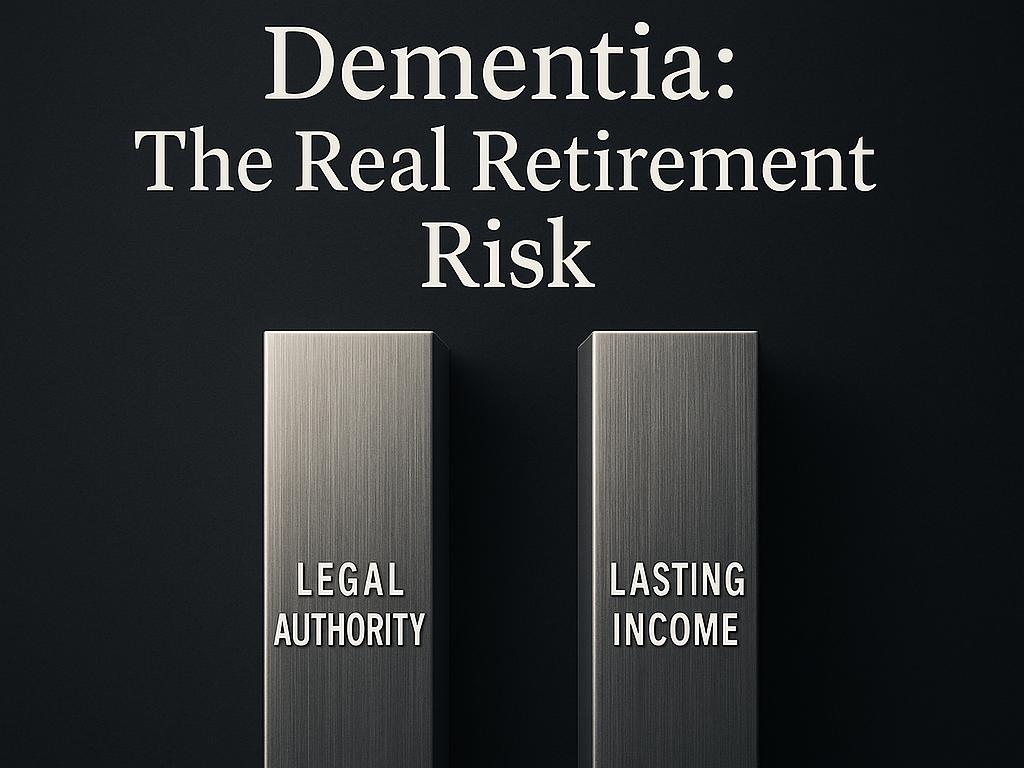
Why Every Family Needs Strong Decision-Making Documents and an Income Plan That Outlives the Human
Most retirement conversations focus on investment risk, tax brackets, or market timing. But after serving Arkansas families for years as an estate planning and elder law attorney, I can say with certainty:
The greatest threat to your retirement is not the stock market. It is cognitive decline — dementia and Alzheimer’s.
These conditions don’t just affect memory. They create a legal, financial, and caregiving crisis that can unravel even the best retirement nest egg. A real long-term care plan has two essential components:
- A legal decision-maker with authority to act, and
- Income that outlives the human so care can continue for years.
Let’s break down why this matters for every family.
Dementia and Alzheimer’s: The Real Retirement Risk
By age 65, the risk of developing some form of cognitive decline increases sharply. When it happens, two things occur immediately:
1. The person loses the ability to manage their own affairs.
Bills stop getting paid. Investments can’t be managed. IRAs can’t be repositioned. Medicaid planning becomes nearly impossible. Even routine decisions require court involvement unless someone has legal authority.
2. Care costs rise dramatically.
Memory care, skilled nursing, in-home support — all of these carry long-term, high-cost price tags. Many families underestimate how long dementia-related care lasts. It is not a three-month crisis. It is typically a multi-year decline.
These two forces — loss of capacity and increased expenses — are what destroy retirement plans.
Why Your Retirement Plan Must Start With Legal Authority
Families are shocked to learn they cannot legally “help” a parent or spouse once dementia appears unless the right documents exist.
A Durable Power of Attorney and a Well-Drafted Trust Are Essential
These documents are not technicalities. They are tools designed to:
- Allow a trusted family member or fiduciary to act immediately
- Execute long-term care strategies without court involvement
- Handle IRAs, annuities, life insurance, and real estate
- Prevent family conflict
- Protect assets from being frozen or mismanaged
Without them, even wealthy families find themselves powerless.
At L. Jennings Law, we draft these documents with modern, Medicaid-aware, long-term care language. Many older powers of attorney simply do not authorize the actions needed to protect a family when dementia strikes.
The Financial Side: You Need Income That Outlives the Human
The second part of a long-term care plan is financial. Dementia-related care often lasts years longer than expected, making longevity of income essential.
Why Traditional “Safe” Income Often Fails
Bonds and fixed income — what many retirees rely on — historically struggle during inflationary periods and long care horizons. Long-term data shows they often:
- Lose purchasing power
- Underperform inflation
- Increase sequence-of-return risk for retirees
- Fail to keep up with long-term care costs
Research on long-horizon returns (including SSRN lifecycle data) demonstrates that inflation and long-term variance make fixed income less reliable for retirees who need multi-year care.
When long-term care stretches over five, eight, even twelve years, you need income that grows, lasts, and is tax-efficient.
The Goal: Income Built to Outlive the Human
A strong plan integrates:
- Proper IRA structuring
- Roth conversion timing (Ed Slott emphasizes the value of tax-free accounts for heirs and late-life planning)
- Withdrawal sequencing
- Real-return investing focused on beating inflation
- Planning for the surviving spouse’s income
Inflation, healthcare costs, and required distributions do not care about your age or situation. Your income must last long enough to meet them.
What Every Family Should Ask
A true retirement plan doesn’t just ask:
“How much do I need to retire?”
It asks:
“Who will make decisions when I can’t, and will my income last long enough to pay for the care I may need?”
This is stewardship — caring for your family long before a crisis occurs.
The Two-Part Long-Term Care Plan Every Family Needs
1. A Legal Decision-Maker With Real Authority

A trust and a durable power of attorney drafted with long-term care language. Without this, every other retirement plan falls apart.
2. An Income Strategy That Outlives the Human
Because dementia doesn’t follow a schedule, and long-term care is not a short-term expense.
When families have both pieces in place, the financial and legal burden of dementia becomes manageable — and the family stays in control.
If You’re Ready to Prepare, We Can Help
At L. Jennings Law, we help Arkansas families design estate and retirement plans that work in real life, not just on paper.
If you or a loved one want to make sure your retirement can withstand dementia, Alzheimer’s, or long-term care needs, schedule a consultation. We’ll walk you through the documents, the planning steps, and the income strategy that protects your family for decades.